A Defence (within the castle of one’s own self) by Graham Domke
“The artist is a mirror to the world. The world is falling apart.”
Steven Parrino, The No Texts
1
May 2026. The artist R. was compelled, for reasons known only to himself, to install 10 tonnes of sand against his studio. A radical confrontation of 500 sandbags. An act of reinforcement, resistance, protest and art for art’s sake. Environmental Art, Conceptual Art and Institutional Critique - inherently serious.
R. was fixated on an image of a San Francisco building fortified with sandbags as a precaution for an air raid in 1942. R. installed his equivalent. More like something you might see at a Documenta or Manifesta. It would look incredible if clandestine-installed in front of a closed-down Cultural Institute or Arts Centre. R. was compelled by himself to make it, so his studio is where it’s at. It is a labour of love. Sometimes you must just listen to your muse and make your own opportunities.
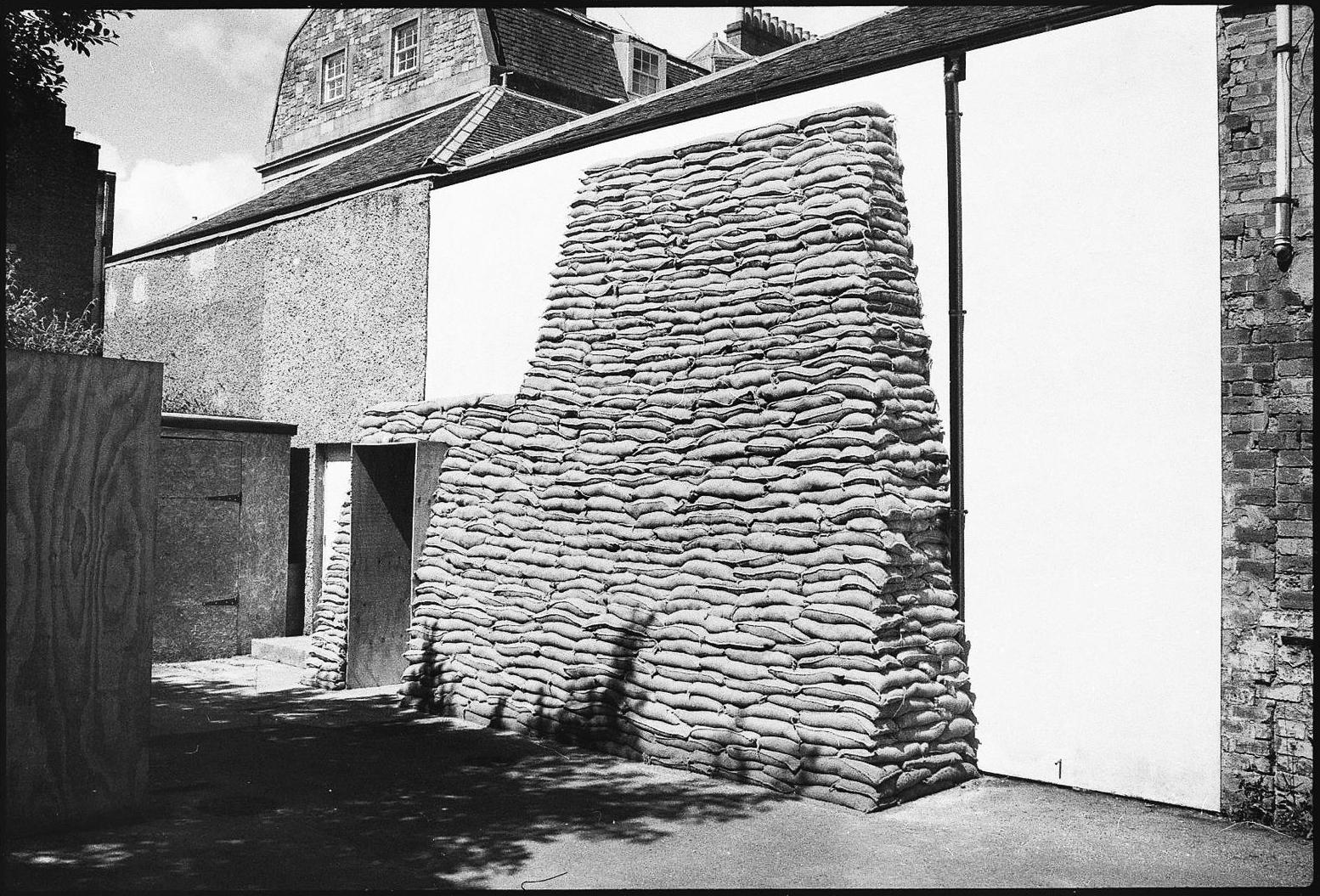 Photograph by Alan Dimmick, 2026
“Nothing remained but to see what he wanted to see. Any fool can turn
a blind eye but who knows what the ostrich sees in the sand.”
Samuel Beckett, Murphy 2
A semaphore is a cypher or coded signal sent, more often than not, as a warning. R.’s message from the near past / future, relayed via a series of stick figures scratched directly onto 16mm film, spelling out the legend ‘No War for Heavy Metal’. A phrase he first came across on friend C.s answer machine phone message, later sourced to the seminal skateboard short film Video Days.3 40 years ago R. had absorbed the practice and the culture of skateboarding, exposing him to the frenetic sound and the rhythmic delivery of bebop, hardcore, hip hop and dub. Later at Art School, appreciating how to look at and make art through the appropriation of Ready Mades, Minimalism and Surrealism. All in a sense preparing R. for this…
“Oh Lord Don’t let ‘em drop it. Stop it, bebop it.”
Charles Mingus, Oh Lord Don’t Let Them Drop that Atomic Bomb
on Me 4
“Armageddon loomed a button-push away. Into this doomsday scenario charged jazz's most intrepid activist… Mingus now took on nuclear brinkmen Kennedy and Khrushchev. No ducking and covering for Mingus. His slow, moaning blues exhorts, "Don't let 'em drop it. Stop it. Bebop it!" 5
Even in the mid-fifties America was a changed place from what it had been only a decade and a half before. Two hot wars and wedged between them, a cold one, plus the growing significance of the atomic bomb as a force that had suddenly transformed the world into a place that was “no longer a series of frontiers, [but] a community which would survive or perish by its own hand” 6
“Nuclear War, they’re talkin’ about Nuclear War. it’s a muthafucka.
Don’t you know. If they push that button. Your ass gotta go.”
Sun Ra, Nuclear War 7
Pacifism, resistance, rebellion, creativity in the face of threat and annihilation. This work is wholly consistent in R.’s longstanding practice of dropped pianos, cut-up Nirvana, super-imposed Beethoven, clouds of frames. Le Drapeau Noir.
February 2022. R. is on residency in Yekaterinberg, in the immediate days before Russia invaded Ukraine. Colours in your Mind … Explode into Space … It’s all too beautiful ... transmitted from floating weather balloons. What comes after It’s all too beautiful?
“I feel inclined to blow my mind.”
Small Faces, Itchycoo Park 8
R.’s studio sits all too close to the law courts where if you protest Genocide and state support for Palestine Action you will be sent down. The studio is a stone's throw to the River Clyde in the heart of Glasgow. Not far at all from the Barclays Campus - Barclays faces boycott campaigns for complicity in war crimes. Then further down the river there is BAE Systems - a large global arms industry company, which clearly benefits from ongoing conflicts, geopolitical tensions and the economy of War. The Clyde serving as a contemporary Apocalypse Now/ Heart of Darkness – another river of existential currents to navigate.
Summer 2019. Loch Long, a submarine on manoeuvres, moving with a slow heavy grace. Dread lurking in a beautiful setting. R. is on residency down the Clyde at Cove Park - a site in close range of the NHNB Clyde, Faslane Submarine base and RNAD Coulport Trident Weapon Store. Also close to the Faslane Peace Camp and a beacon of resistance and protest. R. is on an observation walk undertaken with his friend T. and they experience an uncanny encounter with a patrol of soldiers. At first hidden in plain sight in full combat gear, the soldiers emerge from the landscape like ghosts – ‘I will not be afraid of death and bane, Till Birnam forest come to Dunsinane.’ 9
Today, through the threshold, a timeslip, suspended in animation. The effect is unsettling. Timely. Monumental and low key at the same time. A temporal vortex of the 20th and 21st Centuries. R. has created metaphysical journey through an enigmatic post-apocalyptic landscape, the restricted site of a long-ago disaster, material details charge the atmosphere. An allegory, a reflection of contemporary anxiety, a meditation inside his studio. Dark and Light. Enigmatic, generous but still demanding of an audience required to join the dots for themselves…
“A world that can be explained even with bad reasons is a familiar
world. But, on the other hand, in a universe suddenly divested of
illusions and lights, man feels an alien, a stranger.”
Albert Camus, The Myth of Sisyphus 10
R. has built up a collection of David Pelham book covers and posters. Pelham produced radical new J.G. Ballard book covers for Penguin Books and rendered as posters in Science Fiction Monthly. For The Terminal Beach, Pelham depicts a bomb that has dropped in sand but hasn’t (yet) detonated. In a design for a slipcase to house a Ballard collection, he has a B-29 Superfortress dropped into the sand.
Pelham notes “The horizon continues through each cover, implying that these extraordinary sights are all occurring in the same landscape. An American bomber lies half-buried in the shifting sands while its payload – a sister to the atom bomb that destroyed Nagasaki – rests nose down in the sand flats of The Terminal Beach. The bomb's tail-box tilts skywards like the flower of a strange fruit whose hard shell hides an exotic interior. In the belly of the bomb are the seeds of mass destruction, two stones of a ripening plutonium core waiting for the conditions that will trigger them to germinate.” 11
May 2026, R. acquires a model of the Enola Gay. I can see an affinity with Fiona Banner, specifically her Harrier and Jaguar installation at Tate Britain in 2010. Banner installed actual Harrier and Jaguar fighter planes in the vast Duveen Galleries. "Looking at military hardware in a sculptural sense and exploring not only my, but our fetishization of these extraordinary and yet very disquieting, worrying machines" 12
As a B-29 Superfortress has a wing-spam of 43metres R. has looked through another lens, made do with an accurate model. Even at 1:72 scale, it is sufficiently loaded. It leaves a dark shadow in the exhibition.
“The actual and potential destructiveness of the atomic Bomb plays
straight into the hands of the unconscious. The most cursory study of
the dream-life and fantasies of the insane shows that ideas of world
destruction are latent in the unconscious mind…Nagasaki destroyed by
the magic of science is the nearest man has yet approached to the
realization of dreams that even during the safe immobility of sleep
are accustomed to develop into nightmares of anxiety.”
J.G. Ballard, The Terminal Beach 13
“But the landscape of devastation is still a landscape. There is
beauty in ruins.”
Susan Sontag, Regarding the Pain of Others 14
R. engaged and invited others to do the same. Castles Made of Sand is a fully considered mise-en-scène. Seemingly disparate content converging, to form something cohesive, compelling, absurd and profound. Making art when the world is on fire. On edge when there are multiple wars and atrocities going on. R. and I found ourselves discussing the hourglass, also known as sandglass, sand clock, sand timer. Back out in the lane, blinking in the light, passing the vast stack of sandbags. I saw what I wanted to see.
Graham Domke is a writer and curator based in Glasgow
References
- Steven Parrino, The No Texts; Abaton Books, New Jersey, 2003; p23
- Samuel Beckett, Murphy, Pan, London 1973 p100
- Spike Jonze, Video Days, 1991 https://www.imdb.com/title/tt0375184/
- Charles Mingus, Oh Lord Don’t Let Them Drop that Atomic Bomb on Me, Dreyfus Jazz, USA, 1999
- www.jazz.com/music/charles-mingus-don-t-let-them-drop-that-atomic-bomb-on-me accessed on 2.6.2026
- Leroi Jones, Blues People, Payback Press, Edinburgh 1995 p115
- Sun Ra, Nuclear War, 1982, Y Records, UK
- Small Faces, Itchycoo Park, Immediate, 1967
- Note from Raydale Dower supplied to author, includes quote from Shakespeare’s Macbeth, accessed on 30.5.2026
- Albert Camus, The Myth of Sisyphus, Vintage, New York 2018 p6
- www.penguinsciencefiction.org/19.html accessed on 30.5.2026
- Fiona Banner interviewed www.youtube.com/watch?v=gTAhAkFLkI4 accessed on 29.5.2026
- J.G. Ballard, The Terminal Beach, 1974 Penguin, Middlesex, p136
- Susan Sontag, Regarding the Pain of Others; Penguin, London, 2003; p67